Equine Therapy Benefits for Anxiety, Depression, and PTSD
What the research says about horse therapy for anxiety, depression, PTSD, and burnout. How co-regulation works, and why Kazakhstan's wild horses offer something unique.
There is a reason the horse has been a companion to humanity for over six thousand years. It is not just transportation. It is not even sport. It is something deeper, a bond that predates language, that exists in silence, in breath, in the shared rhythm of two hearts beating across a vast, open steppe.
In the last two decades, science has finally begun to understand what horse people have known for millennia. The relationship between humans and horses is not sentimental. It is biological. And it has measurable effects on the human nervous system, particularly for people struggling with anxiety, depression, post-traumatic stress, and burnout.
What Is Equine-Assisted Therapy?
Equine-assisted therapy (EAT), also called equine-facilitated therapy or horse healing, is a form of experiential therapy that involves interactions with horses to promote emotional, physical, and psychological well-being. Unlike riding schools, where the goal is control and performance, equine therapy is about presence, relationship, and regulation.
The most common forms of equine therapy include:
- Equine-assisted psychotherapy (EAP): Focused on mental health outcomes, usually guided by a licensed therapist alongside an equine specialist.
- Equine-assisted learning (EAL): Focused on personal growth, leadership, and communication skills.
- Therapeutic riding: For physical disabilities and motor skill development.
- Horse healing or horse-assisted mindfulness: Less structured, focused on presence, co-regulation, and nervous system restoration. This is what we offer at Beyond Steppe.
The Science: What Horses Actually Do to the Human Body
Research from the University of Sussex has shown that horses can sense human heart rates from up to several meters away. Their own heart rate synchronizes with yours. If you are anxious, the horse becomes alert. If you are calm, the horse mirrors that calm. This is called co-regulation, a biological process where two beings regulate each other's nervous systems.
In practical terms, this means:
- Cortisol levels drop measurably after 15 minutes of contact with a horse. Cortisol is the primary stress hormone. Lower cortisol means lower anxiety, better sleep, and improved immune function.
- Oxytocin rises, the bonding hormone that creates feelings of connection, trust, and safety. This is the same hormone released during human-to-human bonding, breastfeeding, and deep emotional intimacy.
- Heart rate variability (HRV) improves, which is one of the strongest biomarkers of nervous system resilience and emotional regulation capacity.
- The parasympathetic nervous system activates, shifting the body from "fight or flight" mode into "rest and digest" mode. This is the state where healing, digestion, repair, and emotional processing occur.
Equine Therapy for Anxiety
Anxiety is essentially a nervous system that is stuck in a state of hypervigilance. The body is constantly scanning for threats, even when none exist. This is exhausting, and it makes it impossible to rest, focus, or feel safe.
Horses are uniquely effective for anxiety because they are themselves hypervigilant animals. Their survival depends on reading the environment constantly. But unlike an anxious human, a horse does not ruminate. When the threat passes, the horse returns to grazing. It does not hold onto fear. It does not catastrophize. It simply returns to the present moment.
When an anxious person spends time with a horse, they are literally borrowing the horse's nervous system. The horse's calm becomes their calm. The horse's presence in the present moment pulls them out of the future-oriented worry that defines anxiety. This is not metaphorical. It is measurable in heart rate, cortisol levels, and self-reported anxiety scores.
A 2019 meta-analysis of equine-assisted therapy studies found that participants showed significant reductions in anxiety symptoms compared to control groups, with effect sizes comparable to traditional talk therapy and, in some cases, medication.
Equine Therapy for Depression
Depression often involves a disconnection from the body, from the environment, and from other beings. Depressed people frequently describe feeling numb, heavy, or invisible. The world feels flat and distant.
Horses address depression through connection and embodiment. The physical presence of a horse, its warmth, its breath, its weight, brings you back into your body. The horse's attention, its awareness of you, makes you feel seen in a way that does not require words, performance, or explanation. And the simple act of caring for another being, brushing, walking, being present, can reactivate the sense of purpose and meaning that depression often erodes.
Studies have shown that equine therapy participants report significant reductions in depression scores, increased feelings of self-efficacy, and improved social connection. The effects are often most pronounced in participants who have not responded well to traditional talk therapy or medication.
Equine Therapy for PTSD and Trauma
Trauma, particularly complex trauma and PTSD, involves a nervous system that has been rewired by threat. The body remains in a state of high alert long after the danger has passed. Triggers, flashbacks, hypervigilance, and dissociation are common symptoms. Traditional therapy can be difficult because trauma often lives in the body, not just the mind, and talking about it can sometimes re-traumatize rather than heal.
Equine therapy is particularly effective for trauma because it works below the level of language. The horse does not ask you to explain your trauma. It does not take notes. It does not judge your progress. It simply meets you in the present moment, and its nervous system offers a template for safety that your body can learn to recognize and adopt.
The horse's hypervigilance, which mirrors the trauma survivor's, becomes a bridge. The horse teaches, through its body, that hypervigilance can exist without panic. That awareness can be grounded. That presence can be safe. This is a lesson that the body must learn, not the mind, and horses teach it without a single word.
Research on equine therapy for PTSD, particularly in military veterans, has shown significant reductions in PTSD symptoms, improved sleep quality, and decreased hypervigilance. Many veterans report that the horse is the first being they have felt safe with since returning from combat.
Burnout and Emotional Exhaustion
Burnout is not clinical depression or anxiety, but it shares features with both. It is the result of prolonged stress without recovery, and it leaves people feeling empty, cynical, and disconnected from their work and their lives. Burnout is increasingly common among professionals, caregivers, parents, and anyone living in a high-demand, low-rest environment.
Equine therapy for burnout works because it forces a complete shift in context. You cannot check your email while standing in a field with a horse. You cannot perform or produce. You can only be present. And in that presence, the nervous system begins to recover. The constant low-grade stress of modern life, the ambient noise of deadlines, notifications, and demands, fades. The horse's rhythm becomes your rhythm. The land's silence becomes your silence.
Many of our guests come to us explicitly for burnout recovery. They are doctors, lawyers, executives, teachers, and parents who have spent years giving without replenishing. They leave with something they did not know they had lost: the capacity to rest without guilt.
Why Kazakhstan's Wild Horses Are Different
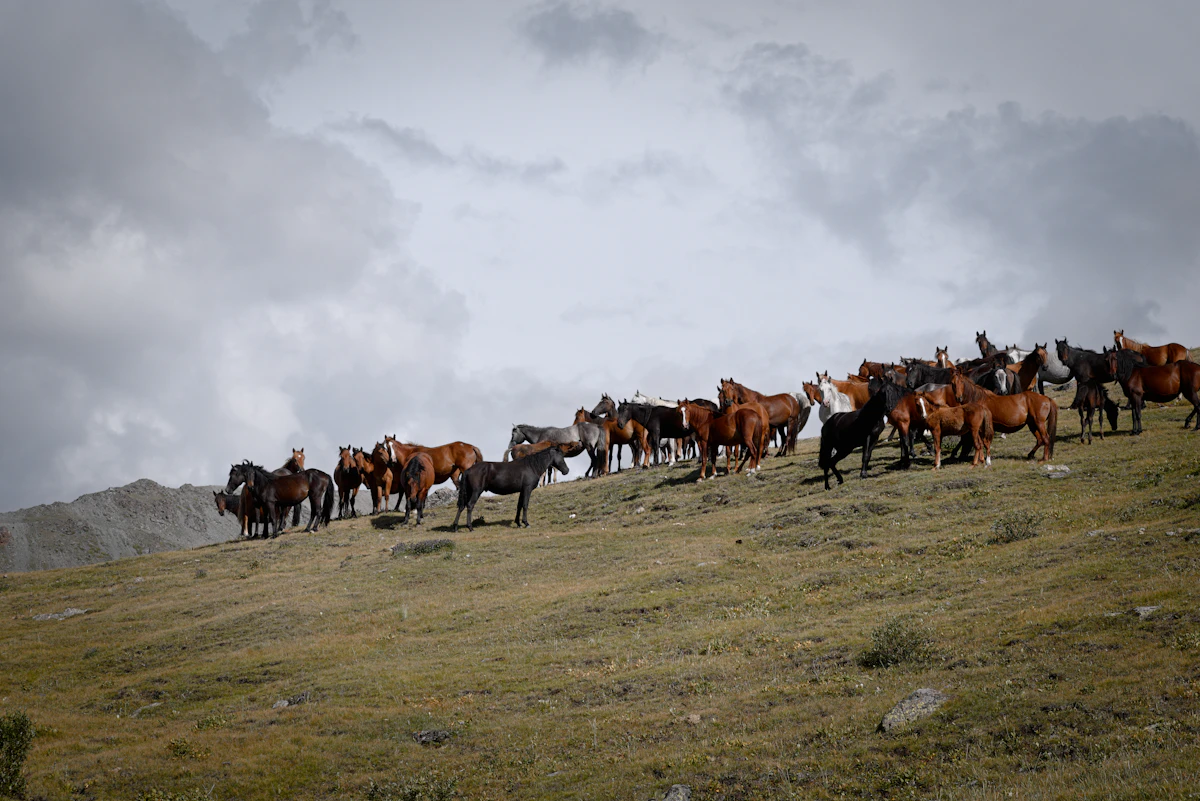
Not all equine therapy is the same. The horses in our program are not therapy horses in the Western sense. They are not trained, handled, or conditioned for human interaction. They are semi-wild herd horses who live in the Tien Shan mountains year-round. They have not been taught to please humans. They have been left alone to be horses.
This makes the interaction more honest. The horse is not performing calm. It is not trained to tolerate you. It is choosing to be near you, or not. That honesty is what makes the co-regulation real. You cannot fake your way through a session with a horse that has never been taught to perform. It reads your actual state, not your presented state. And when it chooses to be near you, you know it is real.
The Evidence, Summarized
Here is what the research consistently shows about equine-assisted therapy:
- Anxiety: Significant reduction in symptoms, with effects comparable to or exceeding traditional talk therapy in some studies.
- Depression: Improved mood, increased self-efficacy, and reduced feelings of isolation.
- PTSD: Decreased hypervigilance, improved sleep, and reduced flashbacks. Particularly effective for treatment-resistant PTSD.
- Burnout: Recovery of emotional capacity, improved sleep, and renewed sense of purpose.
- Social connection: Increased empathy, improved communication, and reduced social anxiety.
- Physical health: Lower cortisol, improved heart rate variability, better immune function, and improved sleep quality.
Is Equine Therapy Right for You?
If you are struggling with anxiety, depression, trauma, or burnout, and traditional approaches have not given you what you need, equine therapy may offer something different. It is not a replacement for medical care or psychotherapy. It is a complement, a tool, and for many people, a breakthrough.
The best way to know if it is right for you is to try it. Not in a clinical setting, but in a place where the land itself is part of the therapy. Where the horses are wild and honest. Where the silence is real. And where you are given permission to stop performing and simply be.
Apply for a retreat here, or email me directly if you have questions about whether this is right for you.
You might also like
What to Expect in Your First Horse Healing Session
Your first equine therapy session can feel unfamiliar. Here is exactly what happens, step by step...
What Is Horse Healing? The Science and Soul Behind Equine Therapy
How horse therapy reduces anxiety, depression, and PTSD symptoms. The science of co-regulation, c...